
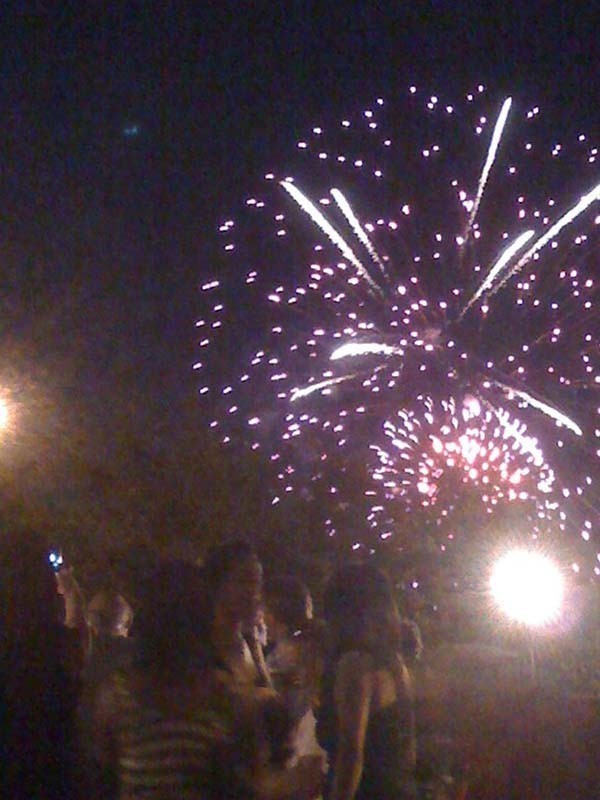

We are approaching one of the best times for shooting off — and shooting — fireworks. I still love fireworks. Every time I see them, I’m in awe with childlike wonder. My favorites are the huge ones with long ember trails that seem to take forever to float down. And, of course, the big ones that are shaped like Texas….
Fireworks can be tricky to photograph with a regular camera. It’s harder with an iPhone, even with the camera of the the newer iPhones and their improved low-light sensitivity. If you’re going to be shooting fireworks over the next few days, here’s my classic post updated, with tips to help you get the best shots possible using your iPhone’s camera.

Shooting Fireworks with an iPhone camera (photo by @itsmestacy)
First, a little background on why it’s so hard to photograph fireworks. You’re shooting fireworks in extremely low light conditions, almost dark. The iPhone’s camera and lens really are not optimized to shoot in situations that dark.
The camera will automatically adjust to a higher ISO rate. This faster ISO makes the camera more light sensitive but it can potentially make your photos look noisy and grainy. It will also adjust to a slow shutter speed, making it more difficult to get sharp photographs without a tripod, but you will get some cool light trails in your photos.
The new low light mode of the iPhone 5 will almost definitely kick in, boosting your camera’s maximum ISO from 800 to 3200. This will make the shutter speed faster which is something you don’t want and will decrease image quality even further. If you have an iPhone 5 or newer, I recommend shooting with one of the third party camera apps below which will give you more control over the ISO and shutter speeds.
Fireworks aren’t limited to the 4th of July, home runs, New Year’s Eve, or Guy Fawkes Night. Bookmark and share this post. These are great tips to keep in mind all year long.
Use a tripod or steady yourself and your iPhone
Even on the newest iPhones, the shutter will probably be open longer than normal. Without a tripod, any movement at all, even the slightest, could mean blurry photos. The best tripod mount I’ve found for an iPhone 5 is the ANYCASE Universal iPhone Tripod Adapter . It’s an extremely versatile tripod mount that will work with any iPhone, including an iPhone 5 — with or without a case. You can also mount your iPhone 4 or 4S to a tripod using a Glif mount, a Diffcase
 or many other options. The Hipstamatic iPhone case for iPhone 4 and 4S even has a standard tripod mount.
Turn off your flash
All it will do is bounce light back from anything that’s near you and cause unwanted light anomalies in your photo.
Use a long-exposure, low-light camera app to capture light trails
I get very good results using Cogitap Software’s Slow Shutter Cam. I started with an exposure of 1 second and also used the app’s Light Trail mode. In the app’s settings, be sure to turn on Auto-Save. Otherwise, Slow Shutter Cam makes you preview and manually save every shot, which increases your chances of missing another great shot. In my tests, I got a lot of good captures with Slow Shutter Cam, especially when compared to Apple Camera. The image with light trails above was taken with Slow Shutter Cam.
Other camera apps, such as 645 PRO and NightCap Pro, also have good low-light modes which allow the iPhone’s shutter to stay open as long as 1 second. Not only does this help bring out and hold the colors of the fireworks, but will also improve your chances of getting some good light trails shots. Allow plenty of time for experimenting.
Don’t laugh, but try practicing beforehand with a YouTube video of fireworks. Be sure the room you’re in is completely dark.
Use a separate exposure lock
Use one of the third-party camera replacements with separate focus and exposure lock,such as 645 PRO, ProCamera, Camera+ or the free Camera Awesome. Lock the focus to infinity (or distance). Lock the exposure to the fireworks. The focus and exposure will probably stay locked for several shots. Locking the exposure on the fireworks will help hold the color and help prevent the colors of the fireworks from blowing out in your photos.
Lock focus on a distant object before shooting
While the regular iPhone camera can do this, you’ll have better results using one of the third party cameras mentioned in this post, specifically those with separate Focus and Exposure locks. Thank yous go to Twitter follower Jag.gr for this tip.
Go easy on the digital zoom
Resist the temptation to use it at all. If you have to, don’t use it very much — not more than 2x. The more you zoom, the more your iPhone camera is susceptible to movement and the greater the chance your images will show blur. It’s much better to get as close as you can and then crop your images down.
Use a self timer set to about half a second
This gives the camera a tiny bit of time to steady after releasing the shutter. All of the camera replacement apps mentioned have self-timers.
Try Shooting Fireworks in Video Mode
Newer iPhones have a very good 1080P video camera built in. You may get better results by shooting fireworks in video mode. From there, you can either select and save screen captures using a third-party app (I use VideoPix). Your screen grabs will save at 1920×1080 pixels — a decent 2.1 megapixels. Or, just share your videos straight to Facebook or Vine.
Take a lot of pictures
Whichever iPhone you are using, fireworks photography is hit-or-miss. In my experience, it’s mostly miss. Take a lot of photos. Most of them won’t come out well. The more photos you take increases the odds of getting more usable fireworks photos.
Don’t expect DSLR-quality images, but you still should be able to get some good photos for sharing. Above all, have a safe and happy holiday. Take the time to look beyond the viewfinder and enjoy the fireworks!
=M=
Have you got your own fireworks shooting tips? Share them in the comments below.
~~~~

